
Gas Grill Won't Light? 7 Easy Fixes Before the Holiday Cook
Posted by The BBQ Authority Team on Nov 13th 2026
Most gas grills that won't light have one of a handful of simple problems: an empty or closed propane tank, a regulator stuck in safety mode, a dead igniter battery, a dirty or misaligned electrode, or a blocked burner. Work through the checks below in order, and you can usually find the culprit in under 15 minutes without any special tools.
It always seems to happen at the worst moment. The turkey is brined, the in-laws are pulling into the driveway, and you press the igniter to hear... click. Click. Nothing. Or the burners catch, but the flame is a weak, lazy blue that barely warms the grates.
Take a breath. Before you call off the cookout, start here.
Safety First: If You Smell Gas, Stop
If you smell gas around the grill, don't keep pressing the igniter. Turn off every burner knob, close the propane tank valve (or the natural gas shutoff), and open the lid to let gas clear. Do a soapy water test on the hose and connections before trying again. If bubbles appear, or the smell doesn't fade, don't use the grill until the leak is repaired. For natural gas lines, call a licensed gas professional.
One more rule worth repeating: always light a gas grill with the lid open. If a burner doesn't light within a few seconds, turn it off and wait about five minutes for the gas to clear before you try again. Your owner's manual has the exact wait time for your model.
Quick Diagnosis: Match the Symptom to the Fix
| What you're seeing | Most likely cause | Try this first |
|---|---|---|
| No click or spark at all | Dead igniter battery or loose wire | Fix 3 |
| Clicking, but no flame | Empty tank, closed valve or dirty electrode | Fixes 1, 4 |
| Flame is tiny and the grill won't get hot | Regulator in bypass (safety) mode | Fix 2 |
| Only one burner won't light | Blocked burner or venturi tube | Fix 5 |
| Yellow, uneven or popping flame | Clogged burner ports or spider webs | Fix 5 |
| Natural gas grill won't light at all | Closed shutoff valve or gas supply issue | Fix 7 |
| Grill struggles only in cold weather | Low tank pressure or moisture | Fix 6 |
The 7 Fixes
1. Check the tank (it's more often empty than you'd think)
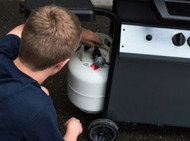
It sounds too simple, but it's the most common cause. Make sure the tank valve is fully open, then check how much propane is left. Many tanks have no gauge, so lift it: a nearly empty 20-pound tank feels surprisingly light. For a more accurate read, weigh it on a bathroom scale and compare it to the "TW" (tare weight) stamped on the collar. The difference is how much propane remains.
Before a holiday cook, keep a full spare on hand. A turkey or prime rib can run for hours, and nobody wants to swap tanks with a half-cooked bird on the grates.
2. Reset the regulator
If your grill lights but the flames stay tiny and it won't climb past a few hundred degrees, the regulator has likely tripped into bypass mode. This is a built-in safety feature that limits gas flow, and it often trips when the tank valve is opened too fast or a burner knob was left on.
To reset it:
- Turn all burner knobs to off.
- Close the tank valve and disconnect the regulator from the tank.
- Wait a minute, then reconnect it snugly by hand.
- Open the tank valve slowly, about a quarter turn at first, then all the way.
- Light the grill following your manual.
This fixes the problem more often than you'd expect. If it keeps happening, the regulator or hose may need replacing.
3. Replace the igniter battery
Many push-button igniters run on a single AA or AAA battery, usually tucked under the igniter button cap. If you press the button and hear nothing, unscrew the cap and swap in a fresh battery. While you're there, check that the wires behind the control panel are firmly connected; they can loosen over time or get chewed by critters.
A neat trick: check for a spark in low light. Press the igniter and look near the burner. A strong blue spark means the igniter works and the problem is gas flow. No spark points back to the battery, the wiring or the electrode.
4. Clean and adjust the electrode
The electrode is the small metal tip near the burner that throws the spark. Grease, rust or food debris can coat it, and a bump can push it too far from the burner. Gently clean the tip with a dry cloth or fine sandpaper, then check that it sits close to the burner ports, as shown in your manual. If the ceramic insulator is cracked, the electrode should be replaced.
5. Clear the burners and venturi tubes
If one burner refuses to light, or the flame burns yellow and uneven, look for a blockage. Spiders and insects love building webs and nests inside the venturi tubes, the narrow pipes that feed gas and air into each burner, especially after a grill sits unused for a few weeks.
Remove the burner following your manual, run a venturi brush or pipe cleaner through the tube, and clear the burner ports with a straightened paper clip or small wire brush. A healthy gas flame should be mostly blue with small yellow tips. Our grill maintenance schedule covers how often to give burners this deeper clean.
6. Account for the cold
Late November grilling in the Midwest comes with its own problems. As temperatures drop, propane tank pressure drops too, especially when the tank is low. That can mean weaker flames and longer preheats. Snow, ice or rain can also dampen the igniter.
Keep the tank as full as you can in winter, store it upright outside in a spot sheltered from wind and snow, and give the grill extra preheat time. Never bring a propane tank indoors to warm it up. For more cold-weather advice, see our Fall & Winter Grilling Tips.
7. For natural gas grills, check the supply
Natural gas grills don't run out of fuel, so the problem is usually upstream. Make sure the shutoff valve on the gas line is fully open, and check whether other gas appliances in the house are working. A grill built for propane won't run correctly on natural gas (or vice versa) without the proper conversion parts, which should be installed by a licensed professional. If everything looks right and the grill still won't light, call a gas professional rather than adjusting fittings yourself.
Backup Plan: Lighting the Grill by Hand
If the igniter is the only problem and dinner can't wait, most gas grills can be lit with a long match or a long-reach lighter. Many models include a match holder or a lighting hole for this. Follow your owner's manual exactly, keep the lid open, and keep your face and hands back from the grill.
When It's Time for New Parts
Some problems won't clean away. Consider replacements if you notice:
- An igniter that won't spark even with a new battery and a clean electrode
- Burners with rust holes, cracks or flames that stay uneven after cleaning
- A cracked, stiff or damaged gas hose
- A regulator that keeps tripping into bypass mode
A few new parts can often bring a well-built grill back to like-new performance, and that's usually far cheaper than replacing the whole grill. BBQ Authority provides warranty support and post-purchase service for all premium grills sold, so if your grill is still under warranty, check with us before you buy parts.
Top Picks to Get Your Grill Holiday-Ready
1. Grill Parts
Replacement burners, igniters and other components to get your grill lighting reliably again.
Genuine parts for Napoleon owners. BBQ Authority is the leading Napoleon grill dealer with the largest in-stock selection available for immediate shipment.
3. Grill Brushes and Grill Scrapers
Keep grates and burners clear so heat stays even and flare-ups stay down.
4. Grill Covers
A good cover keeps rain, snow and spiders out of your burners between cooks.
5. Thermometers
Once the grill is running again, a reliable thermometer makes sure the holiday roast comes out right. Our How to Smoke a Turkey guide has the target temps.
Frequently Asked Questions
Why is my gas grill clicking but not lighting?
Clicking means the igniter is working, so the issue is usually gas flow or the electrode. Check that the tank has propane and the valve is open, then clean the electrode tip and make sure it sits close to the burner.
Why won't my gas grill get hot?
A low flame that won't climb usually means the regulator has tripped into bypass mode. Turn everything off, disconnect and reconnect the regulator, then open the tank valve slowly before relighting.
How do I know if my propane tank is empty?
Weigh it and compare the result to the tare weight (TW) stamped on the collar. The difference is the propane left. If you don't have a scale, a nearly empty tank feels noticeably light.
Why won't one burner on my grill light?
A single dead burner is often blocked by spider webs, insects or grease in the venturi tube or burner ports. Remove the burner and clear it with a venturi brush or pipe cleaner.
Is it safe to light a gas grill with a match?
Many gas grills are designed to be match-lit as a backup. Follow your owner's manual, keep the lid open, and use a long match or long-reach lighter.
What should I do if I smell gas near my grill?
Turn off the burners and the gas supply, open the lid, and don't try to light the grill. Check connections with a soapy water test, and don't use the grill until any leak is repaired.
Get Your Grill Ready Before the Guests Arrive
A grill that won't light is usually a 15-minute fix, not a reason to cancel the cookout. If you've worked through the list and still can't find the problem, we're happy to help. BBQ Authority provides live chat, phone, and email support, and our team can help track down the right replacement parts for your grill. Shop parts and accessories at bbq-authority.com or call 866-238-9228, and get back to the sizzle before the turkey's ready to go on.